In statistics, additive smoothing, also called Laplace smoothing or Lidstone smoothing, is a technique used to smooth count data, eliminating issues caused by certain values having 0 occurrences. Given a set of observation counts x = ⟨ x 1 , x 2 , … , x d ⟩ {\displaystyle \mathbf {x} =\langle x_{1},x_{2},\ldots ,x_{d}\rangle } from a d {\displaystyle d} -dimensional multinomial distribution with N {\displaystyle N} trials, a "smoothed" version of the counts gives the estimator θ ^ i = x i + α N + α d ( i = 1 , … , d ) , {\displaystyle {\hat {\theta }}_{i}={\frac {x_{i}+\alpha }{N+\alpha d}}\qquad (i=1,\ldots ,d),} where the smoothed count x ^ i = N θ ^ i {\displaystyle {\hat {x}}_{i}=N{\hat {\theta }}_{i}} , and the "pseudocount" α > 0 is a smoothing parameter, with α = 0 corresponding to no smoothing (this parameter is explained in § Pseudocount below). Additive smoothing is a type of shrinkage estimator, as the resulting estimate will be between the empirical probability (relative frequency) x i / N {\displaystyle x_{i}/N} and the uniform probability 1 / d . {\displaystyle 1/d.} Common choices for α are 0 (no smoothing), +1⁄2 (the Jeffreys prior), or 1 (Laplace's rule of succession), but the parameter may also be set empirically based on the observed data. From a Bayesian point of view, this corresponds to the expected value of the posterior distribution, using a symmetric Dirichlet distribution with parameter α as a prior distribution. In the special case where the number of categories is 2, this is equivalent to using a beta distribution as the conjugate prior for the parameters of the binomial distribution. == History == Laplace came up with this smoothing technique when he tried to estimate the chance that the sun will rise tomorrow. His rationale was that even given a large sample of days with the rising sun, we still can not be completely sure that the sun will still rise tomorrow (known as the sunrise problem). == Pseudocount == A pseudocount is an amount (not generally an integer, despite its name) added to the number of observed cases in order to change the expected probability in a model of those data, when not known to be zero. It is so named because, roughly speaking, a pseudo-count of value α {\displaystyle \alpha } weighs into the posterior distribution similarly to each category having an additional count of α {\displaystyle \alpha } . If the number of occurrences of each item i {\displaystyle i} is x i {\displaystyle x_{i}} out of N {\displaystyle N} samples, the empirical probability of event i {\displaystyle i} is p i , empirical = x i N , {\displaystyle p_{i,{\text{empirical}}}={\frac {x_{i}}{N}},} but the posterior probability when additively smoothed is p i , α -smoothed = x i + α N + α d , {\displaystyle p_{i,\alpha {\text{-smoothed}}}={\frac {x_{i}+\alpha }{N+\alpha d}},} as if to increase each count x i {\displaystyle x_{i}} by α {\displaystyle \alpha } a priori. Depending on the prior knowledge, which is sometimes a subjective value, a pseudocount may have any non-negative finite value. It may only be zero (or the possibility ignored) if impossible by definition, such as the possibility of a decimal digit of π being a letter, or a physical possibility that would be rejected and so not counted, such as a computer printing a letter when a valid program for π is run, or excluded and not counted because of no interest, such as if only interested in the zeros and ones. Generally, there is also a possibility that no value may be computable or observable in a finite time (see the halting problem). But at least one possibility must have a non-zero pseudocount, otherwise no prediction could be computed before the first observation. The relative values of pseudocounts represent the relative prior expected probabilities of their possibilities. The sum of the pseudocounts, which may be very large, represents the estimated weight of the prior knowledge compared with all the actual observations (one for each) when determining the expected probability. In any observed data set or sample there is the possibility, especially with low-probability events and with small data sets, of a possible event not occurring. Its observed frequency is therefore zero, apparently implying a probability of zero. This oversimplification is inaccurate and often unhelpful, particularly in probability-based machine learning techniques such as artificial neural networks and hidden Markov models. By artificially adjusting the probability of rare (but not impossible) events so those probabilities are not exactly zero, zero-frequency problems are avoided. Also see Cromwell's rule. === Choice of pseudocount === ==== Weakly informative prior ==== One common approach is to add 1 to each observed number of events, including the zero-count possibilities. This is sometimes called Laplace's rule of succession. This approach is equivalent to assuming a uniform prior distribution over the probabilities for each possible event (spanning the simplex where each probability is between 0 and 1, and they all sum to 1). Using the Jeffreys prior approach, a pseudocount of one half should be added to each possible outcome. Pseudocounts should be set to one or one-half only when there is no prior knowledge at all – see the principle of indifference. However, given appropriate prior knowledge, the sum should be adjusted in proportion to the expectation that the prior probabilities should be considered correct, despite evidence to the contrary – see further analysis. Higher values are appropriate inasmuch as there is prior knowledge of the true values (for a mint-condition coin, say); lower values inasmuch as there is prior knowledge that there is probable bias, but of unknown degree (for a bent coin, say). ==== Frequentist interval ==== One way to motivate pseudocounts, particularly for binomial data, is via a formula for the midpoint of an interval estimate, particularly a binomial proportion confidence interval. The best-known is due to Edwin Bidwell Wilson, in Wilson (1927): the midpoint of the Wilson score interval corresponding to z {\displaystyle z} standard deviations on either side is n S + z n + 2 z {\displaystyle {\frac {n_{S}+z}{n+2z}}} Taking z = 2 {\displaystyle z=2} standard deviations to approximate a 95% confidence interval ( z ≈ 1.96 {\displaystyle z\approx 1.96} ) yields pseudocount of 2 for each outcome, so 4 in total, colloquially known as the "plus four rule": n S + 2 n + 4 {\displaystyle {\frac {n_{S}+2}{n+4}}} This is also the midpoint of the Agresti–Coull interval (Agresti & Coull 1998). ==== Known incidence rates ==== Often the bias of an unknown trial population is tested against a control population with known parameters (incidence rates) μ = ⟨ μ 1 , μ 2 , … , μ d ⟩ . {\displaystyle {\boldsymbol {\mu }}=\langle \mu _{1},\mu _{2},\ldots ,\mu _{d}\rangle .} In this case the uniform probability 1 / d {\displaystyle 1/d} should be replaced by the known incidence rate of the control population μ i {\displaystyle \mu _{i}} to calculate the smoothed estimator: θ ^ i = x i + μ i α d N + α d ( i = 1 , … , d ) . {\displaystyle {\hat {\theta }}_{i}={\frac {x_{i}+\mu _{i}\alpha d}{N+\alpha d}}\qquad (i=1,\ldots ,d).} As a consistency check, if the empirical estimator happens to equal the incidence rate, i.e. μ i = x i / N , {\displaystyle \mu _{i}=x_{i}/N,} the smoothed estimator is independent of α {\displaystyle \alpha } and also equals the incidence rate. == Applications == === Classification === Additive smoothing is commonly a component of naive Bayes classifiers. === Statistical language modelling === In a bag of words model of natural language processing and information retrieval, the data consists of the number of occurrences of each word in a document. Additive smoothing allows the assignment of non-zero probabilities to words which do not occur in the sample. Studies have shown that additive smoothing is more effective than other probability smoothing methods in several retrieval tasks such as language-model-based pseudo-relevance feedback and recommender systems.
Human–robot interaction
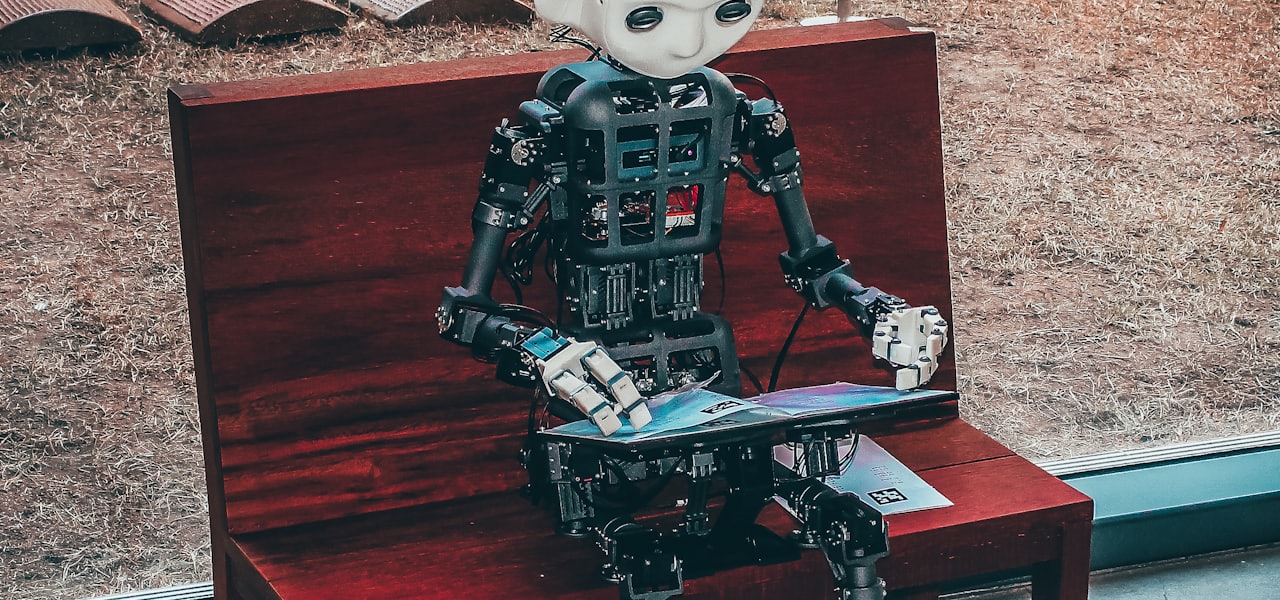
Human–robot interaction (HRI) is the study of interactions between humans and robots. Human–robot interaction is a multidisciplinary field with contributions from human–computer interaction, artificial intelligence, robotics, natural language processing, design, psychology and philosophy. A subfield known as physical human–robot interaction (pHRI) has tended to focus on device design to enable people to safely interact with robotic systems. == Origins == Human–robot interaction has been a topic of both science fiction and academic speculation even before any robots existed. Because much of active HRI development depends on natural language processing, many aspects of HRI are continuations of human communications, a field of research which is much older than robotics. The origin of HRI as a discrete problem was stated by 20th-century author Isaac Asimov in 1941, in his novel I, Robot. Asimov coined Three Laws of Robotics, namely: A robot may not injure a human being or, through inaction, allow a human being to come to harm. A robot must obey the orders given it by human beings except where such orders would conflict with the First Law. A robot must protect its own existence as long as such protection does not conflict with the First or Second Laws. These three laws provide an overview of the goals engineers and researchers hold for safety in the HRI field, although the fields of robot ethics and machine ethics are more complex than these three principles. However, generally human–robot interaction prioritizes the safety of humans that interact with potentially dangerous robotics equipment. Solutions to this problem range from the philosophical approach of treating robots as ethical agents (individuals with moral agency), to the practical approach of creating safety zones. These safety zones use technologies such as lidar to detect human presence or physical barriers to protect humans by preventing any contact between machine and operator. Although initially robots in the human–robot interaction field required some human intervention to function, research has expanded this to the extent that fully autonomous systems are now far more common than in the early 2000s. Autonomous systems include from simultaneous localization and mapping systems which provide intelligent robot movement to natural-language processing and natural-language generation systems which allow for natural, human-esque interaction which meet well-defined psychological benchmarks. Anthropomorphic robots (machines which imitate human body structure) are better described by the biomimetics field, but overlap with HRI in many research applications. Examples of robots which demonstrate this trend include Willow Garage's PR2 robot, the NASA Robonaut, and Honda ASIMO. However, robots in the human–robot interaction field are not limited to human-like robots: Paro and Kismet are both robots designed to elicit emotional response from humans, and so fall into the category of human–robot interaction. Goals in HRI range from industrial manufacturing through Cobots, medical technology through rehabilitation, autism intervention, and elder care devices, entertainment, human augmentation, and human convenience. Future research therefore covers a wide range of fields, much of which focuses on assistive robotics, robot-assisted search-and-rescue, and space exploration. == The goal of friendly human–robot interactions == Robots are artificial agents with capacities of perception and action in the physical world often referred by researchers as workspace. Their use has been generalized in factories but nowadays they tend to be found in the most technologically advanced societies in such critical domains as search and rescue, military battle, mine and bomb detection, scientific exploration, law enforcement, entertainment and hospital care. These new domains of applications imply a closer interaction with the user, sharing the workspace but also goals in terms of task achievement. The subfield of physical human–robot interaction (pHRI) has largely focused on device design to enable people to safely interact with robotic systems but is increasingly developing algorithmic approaches in an attempt to support fluent and expressive interactions between humans and robotic systems. With the advance in AI, the research is focusing on one part towards the safest physical interaction but also on a socially correct interaction, dependent on cultural criteria. The goal is to build an intuitive, and easy communication with the robot through speech, gestures, and facial expressions. Kerstin Dautenhahn refers to friendly Human–robot interaction as "Robotiquette" defining it as the "social rules for robot behaviour (a 'robotiquette') that is comfortable and acceptable to humans" The robot has to adapt itself to our way of expressing desires and orders and not the contrary. But every day environments such as homes have much more complex social rules than those implied by factories or even military environments. Thus, the robot needs perceiving and understanding capacities to build dynamic models of its surroundings. It needs to categorize objects, recognize and locate humans and further recognize their emotions. The need for dynamic capacities pushes forward every sub-field of robotics. Furthermore, by understanding and perceiving social cues, robots can enable collaborative scenarios with humans. For example, with the rapid rise of personal fabrication machines such as desktop 3D printers, laser cutters, etc., entering our homes, scenarios may arise where robots can collaboratively share control, co-ordinate and achieve tasks together. Industrial robots have already been integrated into industrial assembly lines and are collaboratively working with humans. The social impact of such robots have been studied and has indicated that workers still treat robots and social entities, rely on social cues to understand and work together. On the other end of HRI research the cognitive modelling of the "relationship" between human and the robots benefits the psychologists and robotic researchers the user study are often of interests on both sides. This research endeavours part of human society. For effective human – humanoid robot interaction numerous communication skills and related features should be implemented in the design of such artificial agents/systems. == General HRI research == HRI research spans a wide range of fields, some general to the nature of HRI. === Methods for perceiving humans === Methods for perceiving humans in the environment are based on sensor information. Research on sensing components and software led by Microsoft provide useful results for extracting the human kinematics (see Kinect). An example of older technique is to use colour information for example the fact that for light skinned people the hands are lighter than the clothes worn. In any case a human modelled a priori can then be fitted to the sensor data. The robot builds or has (depending on the level of autonomy the robot has) a 3D mapping of its surroundings to which is assigned the humans locations. Most methods intend to build a 3D model through vision of the environment. The proprioception sensors permit the robot to have information over its own state. This information is relative to a reference. Theories of proxemics may be used to perceive and plan around a person's personal space. A speech recognition system is used to interpret human desires or commands. By combining the information inferred by proprioception, sensor and speech the human position and state (standing, seated). In this matter, natural-language processing is concerned with the interactions between computers and human (natural) languages, in particular how to program computers to process and analyze large amounts of natural-language data. For instance, neural-network architectures and learning algorithms that can be applied to various natural-language processing tasks including part-of-speech tagging, chunking, named-entity recognition, and semantic role labeling. === Methods for motion planning === Motion planning in dynamic environments is a challenge that can at the moment only be achieved for robots with 3 to 10 degrees of freedom. Humanoid robots or even 2 armed robots, which can have up to 40 degrees of freedom, are unsuited for dynamic environments with today's technology. However lower-dimensional robots can use the potential field method to compute trajectories which avoid collisions with humans. === Cognitive models and theory of mind === Humans exhibit negative social and emotional responses as well as decreased trust toward some robots that closely, but imperfectly, resemble humans; this phenomenon has been termed the "Uncanny Valley". However recent research in telepresence robots has established that mimicking human body postures and expressive gestures has made the robots likeable and engaging in a remote setting. Further, the presence o
Suffix automaton
In computer science, a suffix automaton is an efficient data structure for representing the substring index of a given string which allows the storage, processing, and retrieval of compressed information about all its substrings. The suffix automaton of a string S {\displaystyle S} is the smallest directed acyclic graph with a dedicated initial vertex and a set of "final" vertices, such that paths from the initial vertex to final vertices represent the suffixes of the string. In terms of automata theory, a suffix automaton is the minimal partial deterministic finite automaton that recognizes the set of suffixes of a given string S = s 1 s 2 … s n {\displaystyle S=s_{1}s_{2}\dots s_{n}} . The state graph of a suffix automaton is called a directed acyclic word graph (DAWG), a term that is also sometimes used for any deterministic acyclic finite state automaton. Suffix automata were introduced in 1983 by a group of scientists from the University of Denver and the University of Colorado Boulder. They suggested a linear time online algorithm for its construction and showed that the suffix automaton of a string S {\displaystyle S} having length at least two characters has at most 2 | S | − 1 {\textstyle 2|S|-1} states and at most 3 | S | − 4 {\textstyle 3|S|-4} transitions. Further works have shown a close connection between suffix automata and suffix trees, and have outlined several generalizations of suffix automata, such as compacted suffix automaton obtained by compression of nodes with a single outgoing arc. Suffix automata provide efficient solutions to problems such as substring search and computation of the largest common substring of two and more strings. == History == The concept of suffix automaton was introduced in 1983 by a group of scientists from University of Denver and University of Colorado Boulder consisting of Anselm Blumer, Janet Blumer, Andrzej Ehrenfeucht, David Haussler and Ross McConnell, although similar concepts had earlier been studied alongside suffix trees in the works of Peter Weiner, Vaughan Pratt and Anatol Slissenko. In their initial work, Blumer et al. showed a suffix automaton built for the string S {\displaystyle S} of length greater than 1 {\displaystyle 1} has at most 2 | S | − 1 {\displaystyle 2|S|-1} states and at most 3 | S | − 4 {\displaystyle 3|S|-4} transitions, and suggested a linear algorithm for automaton construction. In 1983, Mu-Tian Chen and Joel Seiferas independently showed that Weiner's 1973 suffix-tree construction algorithm while building a suffix tree of the string S {\displaystyle S} constructs a suffix automaton of the reversed string S R {\textstyle S^{R}} as an auxiliary structure. In 1987, Blumer et al. applied the compressing technique used in suffix trees to a suffix automaton and invented the compacted suffix automaton, which is also called the compacted directed acyclic word graph (CDAWG). In 1997, Maxime Crochemore and Renaud Vérin developed a linear algorithm for direct CDAWG construction. In 2001, Shunsuke Inenaga et al. developed an algorithm for construction of CDAWG for a set of words given by a trie. == Definitions == Usually when speaking about suffix automata and related concepts, some notions from formal language theory and automata theory are used, in particular: "Alphabet" is a finite set Σ {\displaystyle \Sigma } that is used to construct words. Its elements are called "characters"; "Word" is a finite sequence of characters ω = ω 1 ω 2 … ω n {\displaystyle \omega =\omega _{1}\omega _{2}\dots \omega _{n}} . "Length" of the word ω {\displaystyle \omega } is denoted as | ω | = n {\displaystyle |\omega |=n} ; "Formal language" is a set of words over given alphabet; "Language of all words" is denoted as Σ ∗ {\displaystyle \Sigma ^{}} (where the "" character stands for Kleene star), "empty word" (the word of zero length) is denoted by the character ε {\displaystyle \varepsilon } ; "Concatenation of words" α = α 1 α 2 … α n {\displaystyle \alpha =\alpha _{1}\alpha _{2}\dots \alpha _{n}} and β = β 1 β 2 … β m {\displaystyle \beta =\beta _{1}\beta _{2}\dots \beta _{m}} is denoted as α ⋅ β {\displaystyle \alpha \cdot \beta } or α β {\displaystyle \alpha \beta } and corresponds to the word obtained by writing β {\displaystyle \beta } to the right of α {\displaystyle \alpha } , that is, α β = α 1 α 2 … α n β 1 β 2 … β m {\displaystyle \alpha \beta =\alpha _{1}\alpha _{2}\dots \alpha _{n}\beta _{1}\beta _{2}\dots \beta _{m}} ; "Concatenation of languages" A {\displaystyle A} and B {\displaystyle B} is denoted as A ⋅ B {\displaystyle A\cdot B} or A B {\displaystyle AB} and corresponds to the set of pairwise concatenations A B = { α β : α ∈ A , β ∈ B } {\displaystyle AB=\{\alpha \beta :\alpha \in A,\beta \in B\}} ; If the word ω ∈ Σ ∗ {\displaystyle \omega \in \Sigma ^{}} may be represented as ω = α γ β {\displaystyle \omega =\alpha \gamma \beta } , where α , β , γ ∈ Σ ∗ {\displaystyle \alpha ,\beta ,\gamma \in \Sigma ^{}} , then words α {\displaystyle \alpha } , β {\displaystyle \beta } and γ {\displaystyle \gamma } are called "prefix", "suffix" and "subword" (substring) of the word ω {\displaystyle \omega } correspondingly; If T = T 1 … T n {\displaystyle T=T_{1}\dots T_{n}} and T l T l + 1 … T r = S {\displaystyle T_{l}T_{l+1}\dots T_{r}=S} (with 1 ≤ l ≤ r ≤ n {\displaystyle 1\leq l\leq r\leq n} ) then S {\displaystyle S} is said to "occur" in T {\displaystyle T} as a subword. Here l {\displaystyle l} and r {\displaystyle r} are called left and right positions of occurrence of S {\displaystyle S} in T {\displaystyle T} correspondingly. == Automaton structure == Formally, deterministic finite automaton is determined by 5-tuple A = ( Σ , Q , q 0 , F , δ ) {\displaystyle {\mathcal {A}}=(\Sigma ,Q,q_{0},F,\delta )} , where: Σ {\displaystyle \Sigma } is an "alphabet" that is used to construct words, Q {\displaystyle Q} is a set of automaton "states", q 0 ∈ Q {\displaystyle q_{0}\in Q} is an "initial" state of automaton, F ⊂ Q {\displaystyle F\subset Q} is a set of "final" states of automaton, δ : Q × Σ ↦ Q {\displaystyle \delta :Q\times \Sigma \mapsto Q} is a partial "transition" function of automaton, such that δ ( q , σ ) {\displaystyle \delta (q,\sigma )} for q ∈ Q {\displaystyle q\in Q} and σ ∈ Σ {\displaystyle \sigma \in \Sigma } is either undefined or defines a transition from q {\displaystyle q} over character σ {\displaystyle \sigma } . Most commonly, deterministic finite automaton is represented as a directed graph ("diagram") such that: Set of graph vertices corresponds to the state of states Q {\displaystyle Q} , Graph has a specific marked vertex corresponding to initial state q 0 {\displaystyle q_{0}} , Graph has several marked vertices corresponding to the set of final states F {\displaystyle F} , Set of graph arcs corresponds to the set of transitions δ {\displaystyle \delta } , Specifically, every transition δ ( q 1 , σ ) = q 2 {\textstyle \delta (q_{1},\sigma )=q_{2}} is represented by an arc from q 1 {\displaystyle q_{1}} to q 2 {\displaystyle q_{2}} marked with the character σ {\displaystyle \sigma } . This transition also may be denoted as q 1 σ ⟶ q 2 {\textstyle q_{1}{\begin{smallmatrix}{\sigma }\\[-5pt]{\longrightarrow }\end{smallmatrix}}q_{2}} . In terms of its diagram, the automaton recognizes the word ω = ω 1 ω 2 … ω m {\displaystyle \omega =\omega _{1}\omega _{2}\dots \omega _{m}} only if there is a path from the initial vertex q 0 {\displaystyle q_{0}} to some final vertex q ∈ F {\displaystyle q\in F} such that concatenation of characters on this path forms ω {\displaystyle \omega } . The set of words recognized by an automaton forms a language that is set to be recognized by the automaton. In these terms, the language recognized by a suffix automaton of S {\displaystyle S} is the language of its (possibly empty) suffixes. === Automaton states === "Right context" of the word ω {\displaystyle \omega } with respect to language L {\displaystyle L} is a set [ ω ] R = { α : ω α ∈ L } {\displaystyle [\omega ]_{R}=\{\alpha :\omega \alpha \in L\}} that is a set of words α {\displaystyle \alpha } such that their concatenation with ω {\displaystyle \omega } forms a word from L {\displaystyle L} . Right contexts induce a natural equivalence relation [ α ] R = [ β ] R {\displaystyle [\alpha ]_{R}=[\beta ]_{R}} on the set of all words. If language L {\displaystyle L} is recognized by some deterministic finite automaton, there exists unique up to isomorphism automaton that recognizes the same language and has the minimum possible number of states. Such an automaton is called a minimal automaton for the given language L {\displaystyle L} . Myhill–Nerode theorem allows it to define it explicitly in terms of right contexts: In these terms, a "suffix automaton" is the minimal deterministic finite automaton recognizing the language of suffixes of the word S = s 1 s 2 … s n {\displaystyle S=s_{1}s_{2}\dots s_{n}} . The right context of the word ω {\displaystyle \omeg
Simon Godsill
Simon John Godsill (born 2 December 1965) is professor of statistical signal processing at the University of Cambridge, and a professorial fellow at Corpus Christi College. He is also a member of the Centre for Science and Policy. His main area of research is Bayesian statistics and stochastic sampling methodologies, particularly particle filtering. == Education == Godsill obtained both undergraduate and Ph.D. degrees from the Department of Engineering at Cambridge University, whilst a member of Selwyn College. He obtained a first class degree in the Electrical and Information Sciences Tripos. The title of his 1993 Ph.D. thesis was "The Restoration of Degraded Audio Signals" and his Ph.D. supervisor was Peter Rayner, whom he shared with Michael Richard Lynch. == Career == Godsill has published over 250 articles in peer reviewed journals, along with the books Digital audio restoration: a statistical model based approach and Compressed sensing & sparse filtering. == Business interests == Godsill is currently a director of CEDAR Audio Ltd, a Cambridge-based company that applies Bayesian mathematics for purposes of noise reduction in audio data. In February 2005, the company received a Sci-Tech Academy Award (a 'Technical Oscar') for its services to the movie industry, and a stream of innovations appeared over the following years with corresponding recognition including induction into the Audio Technology Hall of Fame (2008), a Cinema Audio Society Award (2009). Godsill is also a director at Input Dynamics Ltd, a Cambridge-based company that applies Bayesian techniques to touch screen technology. Godsill is involved with the research effort at BMLL Technologies, a Cambridge spin-off working in the field of machine learning application in the financial sector.
AI Background Removers Reviews: What Actually Works in 2026
Trying to pick the best AI background remover? An AI background remover is software that uses machine learning to help you get more done — it scales effortlessly from a single task to thousands. The best picks balance beginner-friendly simplicity with the depth power users need, and they ship updates often. Whether you are a beginner or a pro, the right AI background remover slots into your workflow and pays for itself fast. This guide breaks down the top picks, their pros and cons, and who each one is best for.
Nobody (username)
In many Unix variants, "nobody" is the conventional name of a user identifier which owns no files, is in no privileged groups, and has no abilities except those which every other user has. It is normally not enabled as a user account, i.e. has no home directory or login credentials assigned. Some systems also define an equivalent group "nogroup". == Uses == The pseudo-user "nobody" and group "nogroup" are used, for example, in the NFSv4 implementation of Linux by idmapd, if a user or group name in an incoming packet does not match any known username on the system. It was once common to run daemons as nobody, especially on servers, in order to limit the damage that could be done by a malicious user who gained control of them. However, the usefulness of this technique is reduced if more than one daemon is run like this, because then gaining control of one daemon would provide control of them all. The reason is that processes owned by the same user have the ability to send signals to each other and use debugging facilities to read or even modify each other's memory. Modern practice, as recommended by the Linux Standard Base, is to create a separate user account for each daemon.
Julie Beth Lovins
Julie Beth Lovins (October 19, 1945, in Washington, D.C. – January 26, 2018, in Mountain View, California) was a computational linguist who published The Lovins Stemming Algorithm - a type of stemming algorithm for word matching - in 1968. The Lovins Stemmer is a single pass, context sensitive stemmer, which removes endings based on the longest-match principle. The stemmer was the first to be published and was extremely well developed considering the date of its release, having been the main influence on a large amount of the future work in the area. -Adam G., et al == Background == Born on October 19, 1945, in Washington, D.C., Lovins grew up in Amherst, Massachusetts. Her father Gerald H. Lovins was an engineer and her mother, Miriam Lovins, a social services administrator. Lovins' brother Amory Lovins is the co-founder and chief environmental scientist of Rocky Mountain Institute. For her undergraduate degree, Lovins attended Pembroke College, the women's college of Brown University, which later combined into Brown University in 1971. At Pembroke College, Lovins studied mathematics and linguistics, graduating with honors. Her thesis was named, A Study of Idioms. She received the inaugural Bloch Fellowship in 1970 from the Linguistic Society of America to attend graduate school. Lovins obtained her Master of Arts in 1970 and Doctor of Philosophy in 1973 from the University of Chicago, studying linguistics. At the University of Chicago, her dissertation was titled, Loan Phonology -- Subject Matter. A revision of her thesis on loanwords and the phonological structure of Japanese was published in 1975 by the Indiana University Linguistics Club. == Teaching career == Following Lovins' PhD, she spent a year working as a linguist-at-large at a University of Tokyo language research institute and as an English conversation teacher. She then joined the faculty at Tsuda College as a professor of English and linguistics, where she taught for seven years. During her time as a faculty member at Tsuda College, Lovins also served as a guest researcher in the University of Tokyo's Research Institute of Logopedics and Phoniatrics, a research center for speech science. == Industry career == After teaching Japanese phonology at Japanese universities abroad, Lovins moved back to the U.S. to work in the computing industry. She worked on early speech synthesis at Bell Labs in Murray Hill, New Jersey. At Bell Labs, Lovins worked with Osamu Fujimura, a Japanese linguist who is credited as a pioneer in speech sciences. Lovins also worked as a software engineer at various companies in Silicon Valley and served as a consultant for computational linguistics throughout the 1990s. As a consultant, she called her business, "The Language Doctor." == The Lovins Stemming Algorithm == Lovins published an article about her work on developing a stemming algorithm through the Research Laboratory of Electronics at MIT in 1968. Lovins' stemming algorithm is frequently referred to as the Lovins stemmer. A stemming algorithm is the process of taking a word with suffixes and reducing it to its root, or base word. Stemming algorithms are used to improve the accuracy in information retrieval and in domain analysis. These algorithms help find variants of the terms being queried. Stemming algorithms bring value in their reduction of a given query into its less complex form, allowing more similar documents to be retrieved for similar queries. Stemming algorithms are prevalent in search engines, such as Google Search, which did not implement word stemming until 2003. This means that up until 2003, a Google search for the word warm would not have explicitly returned results for related words like warmth or warming. As the first published stemming algorithm, Lovins' work set a precedent and influenced future work in stemming algorithms, such as the Porter Stemmer published by Martin Porter in 1980 which has been recognized widely as the most common stemming algorithm for stemming English. Additionally, the Dawson Stemmer developed by John Dawson is an extension of the Lovins stemmer. The Lovins stemmer follows a rule-based affix elimination approach. It first removes the longest identifiable suffix from the target word - producing a base stem word - then indexes a lookup table to convert the (potentially malformed) stem word to a valid word. This process can be split into two phases. In the first phase, a word is compared with a pre-determined list of endings, and when a word is found to contain one of these endings, the ending is removed, leaving only the stem of the word. The second phase standardizes spelling exceptions that come from the first phase, ensuring that words with only marginally varying stems are appropriately paired together. For example, with the word dried, phase one results in dri, which should match with the word dry. The second phase takes care of these exceptions. Compared to other stemmers, Lovins' algorithm is fast and equipped to handle irregular plural words like person and people. Disadvantages, however, include many suffixes not being available in the table of endings. Furthermore, it is sometimes highly unreliable and frequently fails to form valid words from the stems or to match the stems of like-meaning words. This is most often caused by the usage of specialist terminology and domain-specific vocabulary by the author. == Personal life == Lovins moved to Mountain View, California, in 1979, and later to Old Mountain View in 1981 with her partner and later husband Greg Fowler, a software engineer and advocate for environmental issues & the blind. In their free time, she and her husband enjoyed taking walks and volunteering for their local community. Lovins actively volunteered for organizations like the Old Mountain View Neighborhood Association, Mountain View Friends of the Library, League of Women Voters, Mountain View Cool Cities Team, and the Mountain View Sustainability Task Force. In 2016, Lovins' husband died unexpectedly, following a heart attack. Eighteen days after her husband died, Lovins was diagnosed with brain cancer. She died on January 26, 2018, at a hospice, surrounded by friends, family and caregivers.